Introduction
In embedded product development, the decisions you make affect your timeline, your budget, and how long your product can stay on the market. One of the most impactful decisions you'll make early on is how you build your computing core.
System-on-Modules (SOMs) are compact, board-level circuits that come pre-built with the essential components of an embedded processing system: the CPU, RAM, storage, and often connectivity. Rather than designing all of that from scratch, your team plugs a SOM into a custom carrier board and gets straight to work on what actually differentiates your product.
In this article, we explain the reasons why choosing a SOM for your next embedded project may be a smart decision.
cpu
1. Faster Time-to-Market
Designing a custom board from scratch is a serious undertaking. You're dealing with complex, multi-layer PCBs, BGA component placement, signal integrity challenges, and more, before you get something stable. That process takes a lot of time.
SOMs remove the hardest part of that work. The computing core is already designed, manufactured, and validated. Your team can move directly to carrier board development and application-specific features.
Companies deciding to implement SOMs instead of fully custom designs in their workflow commonly report saving development time, even up to 12 months. In fast-moving markets, that lead time is often the difference between being first and playing catch-up.
2. Long-Term Availability
Consumer-level SBCs are great for tinkering. They're not designed for products that need to stay in production for a decade.
Embedded applications (especially in industrial, medical, or infrastructure contexts) require component availability guarantees that hobby-market products simply can't offer. Grinn SOMs come with a 10+ year availability commitment, built on processors from partners like MediaTek, Renesas, and Synaptics who offer comparable long-term supply guarantees.
3. Small Form Factor
Size constraints are a reality in most embedded designs. Whether you're building a smart sensor, a portable medical device, or an industrial controller, the board has to fit - and compact designs don't leave room for oversized hardware. SOMs are inherently space-efficient, packing substantial processing power into a very small footprint.
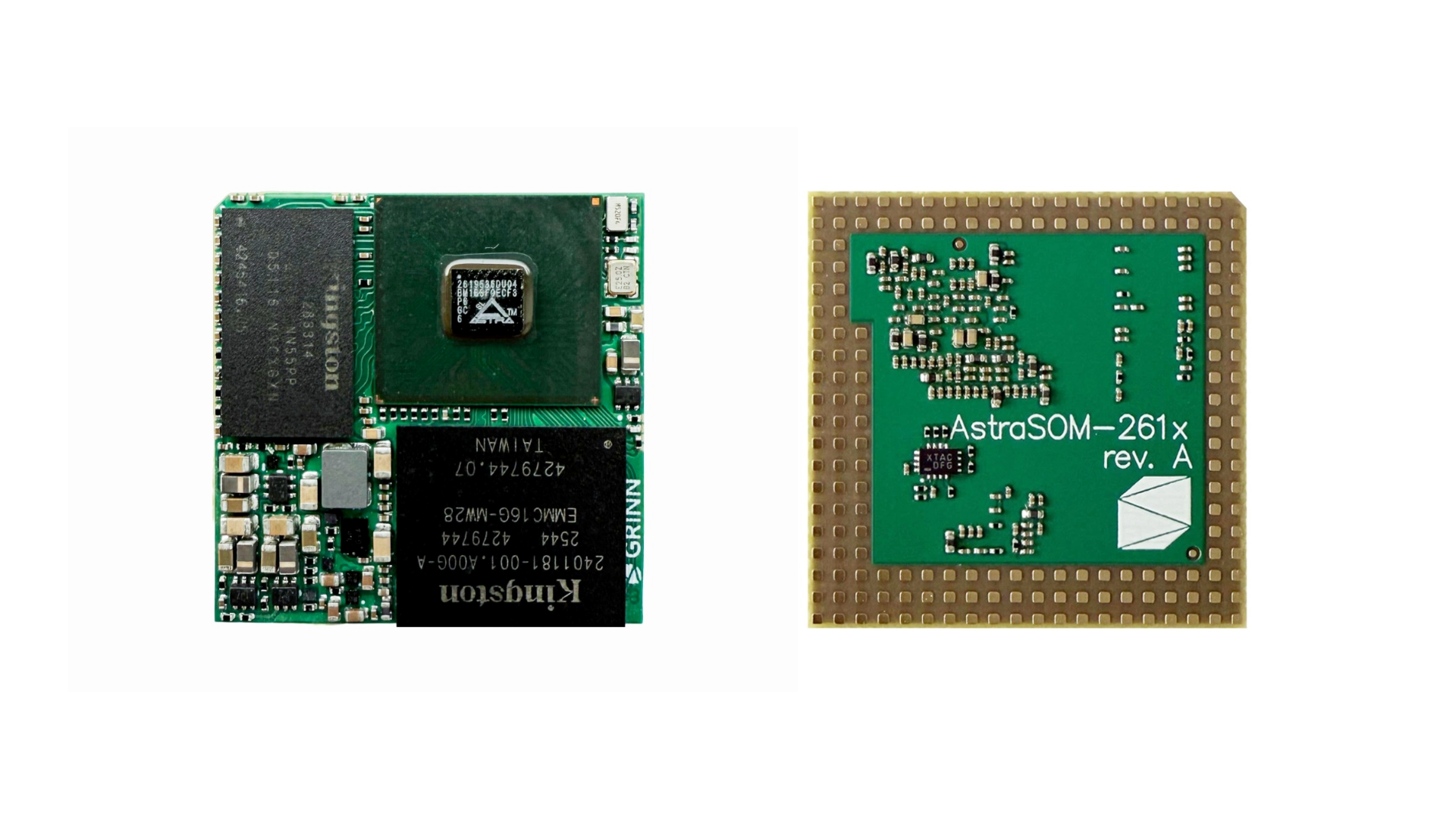
At Grinn, we push this further: our goal is to build the world's smallest SOM for each processor line we work with. A good example is the Grinn AstraSOM-261x, which measures just 25 × 25 mm, thus giving developers the computational capability they need without sacrificing precious space on the carrier board.
4. Edge AI Readiness
Edge AI, in short, means performing AI inference directly on the device, without relying on cloud connectivity. This technology is becoming a core capability of next-generation embedded systems. Processing locally removes the dependency on network access that can make or break an application in challenging environments.
All the latest Grinn SOMs are built with Edge AI in mind, with high-performance modules featuring integrated NPUs delivering up to 8 TOPS of AI processing power. That range gives developers flexibility to match the right level of compute to the application, whether that's a lightweight inference task or a more demanding vision pipeline - all running entirely on-device.
5. Industrial-Grade Temperature Range
A processor that performs flawlessly on your lab bench can behave very differently when it's deployed on a factory floor, inside outdoor enclosures, or in cold storage environments. Consumer and hobbyist hardware typically has a limited operating range - fine for a desk, but often not for the real world.
All Grinn SOMs are rated for an industrial operating temperature range of -40°C to +85°C. If your device is going into a demanding environment, this kind of reliability is necessary.
6. Cost Efficiency
At first glance, buying a pre-built module might seem more expensive than sourcing individual components. Factor in the full picture, though, and SOMs can come out ahead on total cost - especially for low-to-medium volume production runs.
Custom board design involves significant engineering hours, multi-layer HDI PCB fabrication, assembly costs, and the very real expense of prototype respins when something doesn't work. SOM manufacturers absorb those costs by producing modules at scale, and that efficiency gets passed down.
You also benefit from their supply chain - no need to meet high minimum order quantities on expensive processors or memory. And because your carrier board is inherently simpler than a full custom design, the risk and cost of getting it right is much lower. SOMs de-risk the early stages of development when the cost of mistakes is highest.
7. Design Flexibility and Scalability
One of the quieter advantages of SOMs is how well they support product families and long-term evolution.
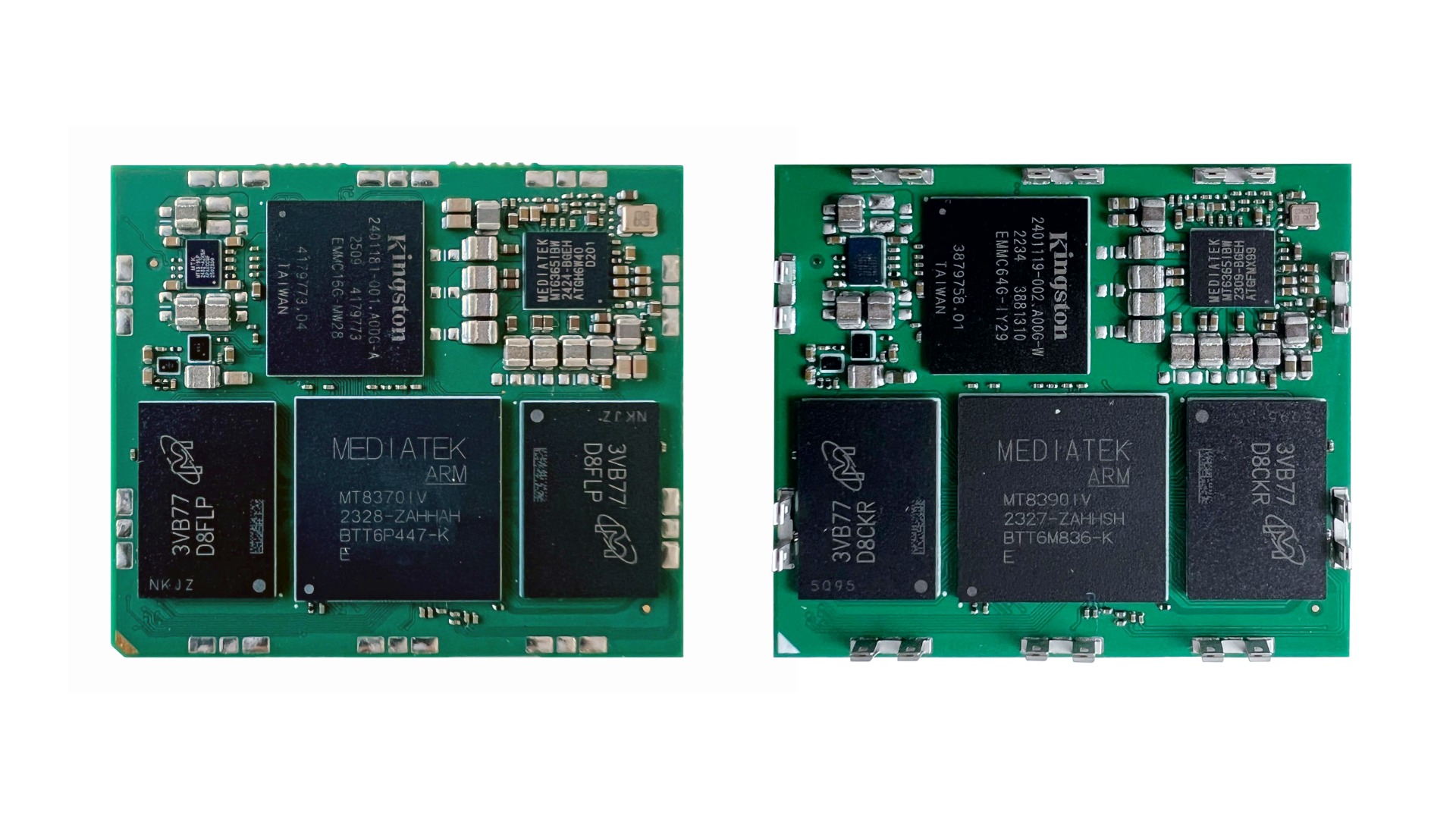
Because a SOM is a self-contained modules, it can often be swapped with a different variant - higher performance, lower power, different connectivity - while the carrier board stays the same. That means you can build a single baseboard designed to support a range of performance levels, creating entry-level and premium versions of your product by choosing different SOMs (e.g. with the Grinn GenioSOM-510 or the 700 version). It also means that when a newer processor becomes available, upgrading your product line can be achieved with significantly less redesign compared to a full custom board.
This modularity extends across projects, too. If your team builds multiple products, a common SOM can be reused across all of them, each with its own purpose-built carrier. That's significant leverage on hardware investment.
Summary
System-on-Modules aren't the answer for every project - but for embedded product teams building serious, long-lived devices, they offer a compelling combination of speed, reliability and flexibility. The heavy lifting of computing core design is done. Your team can spend its time on what actually makes your product worth building.
If you'd like to explore whether a Grinn SOM is the right fit for your application, check out the Products section on our website or contact us directly!



 Paweł Horbanowicz