Introduction
Integrating a modern processor onto a custom carrier board is a long process that requires very specific hardware expertise - and time investment that many product teams would rather avoid.
System-on-Modules (SOMs) address this issue directly. With the core compute, memory, and power sequencing handled on-module, your carrier board design is simplified to routing only the specific peripheral I/O required for your application. That's a much narrower scope.
At Grinn, we develop SOMs in partnership with several leading semiconductor companies. Our MediaTek-based lineup, built on the Genio processor family, currently includes four modules - each suited to different performance and form factor requirements. This article walks you through the differences between them to help you choose the right platform for your project.
The Grinn GenioSOM Family
The GenioSOM lineup currently consists of:
- Grinn GenioSOM-360P: the newest and smallest of the four, with the highest NPU throughput, built on the octa-core MediaTek Genio 360P processor;
- Grinn GenioSOM-360: a more value-oriented sibling in the same footprint, built on the hexa-core MediaTek Genio 360 processor;
- Grinn GenioSOM-510: a power-efficient module for multimedia and AI workloads, built on the MediaTek Genio 510;
- Grinn GenioSOM-700: the highest CPU and GPU throughput of the four, built on the MediaTek Genio 700.
The Grinn GenioSOM-360 and GenioSOM-360P are currently in production and not yet available to order. We'll announce availability soon.
The 510 and 700 look similar at first glance. They share an identical 37.0 × 42.6 mm form factor, the same LGA-312 footprint, and the same carrier board pinout - meaning a design built for the Grinn GenioSOM-510 can be upgraded to the Grinn GenioSOM-700 without any layout changes. The difference is headroom: more CPU cores, a more capable GPU, and a higher NPU throughput on the 700.
The Grinn GenioSOM-360 and GenioSOM-360P follow the same logic at a smaller scale. Both share a 30 × 30 mm footprint and a 303-pad LGA form factor, distinct from the 510/700 pair, so a carrier board designed for one can accept the other without a redesign. Here too, it's the processor that sets them apart: the 360P adds an extra Cortex-A76 core and an extra Cortex-A55 core, plus roughly 45% higher NPU throughput, over the 360. If board space is the binding constraint on your design, the 360 family is the right choice - which of the two you pick comes down to how much AI headroom you need.
Below, you will find more information about each of these four SOMs.
Grinn GenioSOM-360 and 360P
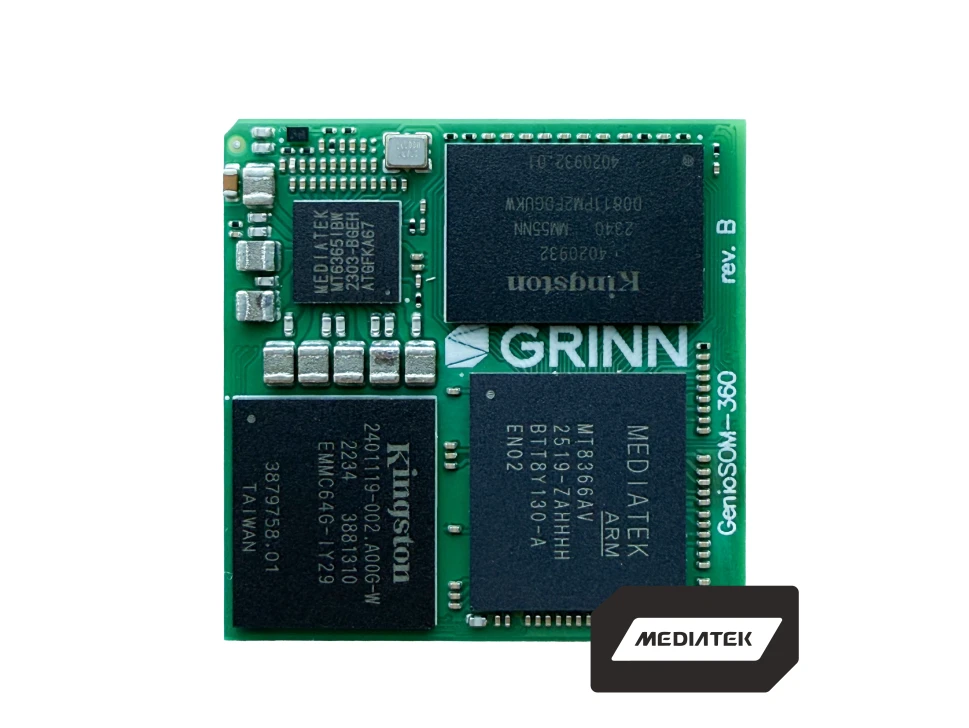
The Grinn GenioSOM-360P is the most recently launched module in the family, and currently the smallest SoM on the market based on this processor. The Grinn GenioSOM-360 is its more affordable sibling, built on the same board design and footprint but around a lighter processor. Both were designed from the ground up for applications where physical size matters as much as compute capability - the difference is how much AI performance you need inside that footprint.
| Specification | Grinn GenioSOM-360 | Grinn GenioSOM-360P |
|---|
| SoC | MediaTek Genio 360 (MT8366) | MediaTek Genio 360P (MT8367) |
| CPU | 1× Arm Cortex-A76, 5× Arm Cortex-A55 (hexa-core) | 2× Arm Cortex-A76, 6× Arm Cortex-A55 (octa-core) |
| GPU | Arm Mali-G57 MC2 | Arm Mali-G57 MC2 |
| NPU | 5.1 TOPS (8th Gen. MDLA 5.3) | 7.4 TOPS (8th Gen. MDLA 5.3) |
| RAM | Up to 8 GB LPDDR4X | Up to 8 GB LPDDR4X |
| Storage | Up to 64 GB eMMC 5.1 | Up to 64 GB eMMC 5.1 |
| Display | MIPI DSI, LVDS, eDP/DP | MIPI DSI, LVDS, eDP/DP |
| Video Input | 2x MIPI CSI-2 | 2x MIPI CSI-2 |
| Interfaces | PCIe Gen2, USB 3.0, 2× USB 2.0, GbE, CAN-FD | PCIe Gen2, USB 3.0, 2× USB 2.0, GbE, CAN-FD |
| Form Factor | 30 × 30 mm, LGA-303 | 30 × 30 mm, LGA-303 |
| Temperature Range | −20°C to 70°C (Extended), TBD (Industrial) | −20°C to 70°C (Extended), TBD (Industrial) |
Best use cases
Both modules are built for designs where space is the primary constraint, and integrated CAN-FD makes both a solid fit for industrial networking and automation controllers that need real-time AI inference within a 30 × 30 mm footprint. The Grinn GenioSOM-360P's extra CPU headroom and 7.4 TOPS NPU make it the right pick when the workload itself is demanding - local Small Language Models (SLMs), high-speed object detection, or multi-sensor fusion in compact drones, wearable medical monitors, or smart sensors. The Grinn GenioSOM-360 covers the same class of products at a lower cost, for designs that don't need that much AI headroom - simpler vision tasks, keyword spotting, or basic sensor hubs.
Grinn GenioSOM-510 and 700
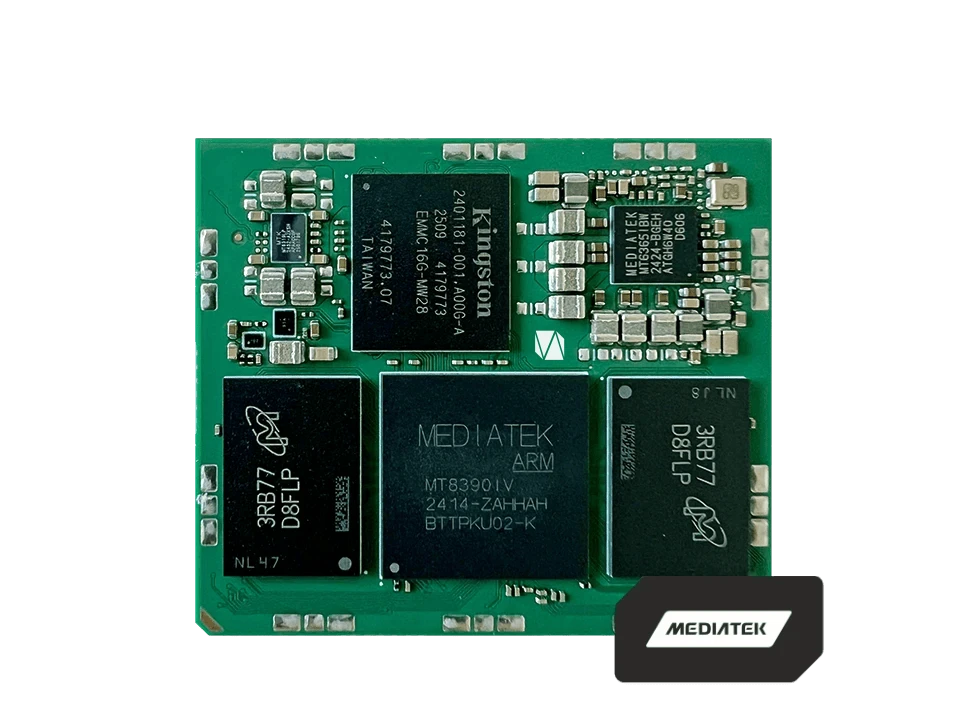
The Grinn GenioSOM-510 and GenioSOM-700 share the same board design, and the difference between them comes down to how much headroom your application needs.
What sets the Grinn GenioSOM-510 apart is its power efficiency relative to its performance tier. It delivers solid 4K multimedia and real-time AI inference at a thermal profile that doesn't demand active cooling or complex power design - making it the easiest of the four to integrate into fanless, battery-powered, or cost-sensitive products.
It also serves as a low-risk entry point into the 510/700 platform: because it's pin-compatible with the Grinn GenioSOM-700, teams can prototype and validate their carrier board on the 510 and swap to the 700 later if workloads grow.
The Grinn GenioSOM-700 is the right choice when your application demands the most from the processor and GPU. Of the four, it has the most capable CPU, the largest GPU, and the fastest video decode. The 700 is a great choice for workloads that combine heavy video processing, multi-camera input, and a complex UI running simultaneously. It's currently also the only one of the two qualified for the extended −40°C to 85°C industrial temperature range.
| Specification | Grinn GenioSOM-510 | Grinn GenioSOM-700 |
|---|
| SoC | MediaTek Genio 510 (MT8370) | MediaTek Genio 700 (MT8390) |
| CPU | 2× Arm Cortex-A78, 4× Arm Cortex-A55 | 2× Arm Cortex-A78, 6× Arm Cortex-A55 |
| GPU | Arm Mali-G57 MC2 | Arm Mali-G57 MC3 |
| NPU | 3.2 TOPS (5th Gen.) | 4.0 TOPS (5th Gen.) |
| RAM | 4 GB LPDDR4 (up to 8 GB) | 4 GB LPDDR4 (up to 8 GB) |
| Storage | 16 GB eMMC (up to 64 GB) | 16 GB eMMC (up to 64 GB) |
| Display | 1× HDMI 2.0, 1× DP 1.4, 1× eDP 1.2, 2× MIPI-DSI (4L) | 1× HDMI 2.0, 1× DP 1.4, 1× eDP 1.2, 2× MIPI-DSI (4L) |
| Video Input | 2× MIPI CSI-2 (4L) | 2× MIPI CSI-2 (4L) |
| Interfaces | PCIe 2.0, USB 3.1 Gen1, 2× USB 2.0, GbE MAC | PCIe 2.0, USB 3.1 Gen1, 2× USB 2.0, GbE MAC |
| Form Factor | 37 × 42.6 mm, LGA-312 | 37 × 42.6 mm, LGA-312 |
| Temperature Range | −20°C to 70°C (Extended), −40°C to 85°C (Industrial) | −20°C to 70°C (Extended), −40°C to 85°C (Industrial) |
Best use cases
The Grinn GenioSOM-510 is the practical option for fanless or battery-powered devices that need solid 4K multimedia performance without high thermal demands. It's a natural fit for interactive retail kiosks, smart home appliances, and HMI panels with a single 4K display. It's also well-suited for moderate AI tasks like gesture control or facial recognition, helped by the Tensilica Vision Processor (VP6) built into its NPU alongside the MDLA accelerator. Its shared footprint with the Grinn GenioSOM-700 also makes it a low-risk base for product families that may scale to heavier workloads later.
The Grinn GenioSOM-700 is built for high-throughput applications that demand concurrent processing and multi-display output. Its dedicated Tensilica Vision Processor and dual 4K display support make it the go-to for multi-camera systems, autonomous mobile robots (AMRs) with sensor fusion, and medical diagnostic workstations. It handles heavy parallel workloads (like rendering a 3D UI across two screens while processing multiple high-speed camera streams) making it the best option for demanding industrial and professional applications.
Development boards
If you'd rather validate your application before committing to a custom carrier board, there is also the Grinn GenioBoard - an open-hardware SBC built around the Grinn GenioSOM-700. It breaks out the module's key interfaces onto a 40-pin header, alongside HDMI and DisplayPort outputs, dual MIPI-CSI camera connectors, Gigabit Ethernet, and two M.2 sockets - one PCIe Gen2 slot for AI accelerators, and one for Wi-Fi/Bluetooth modules.
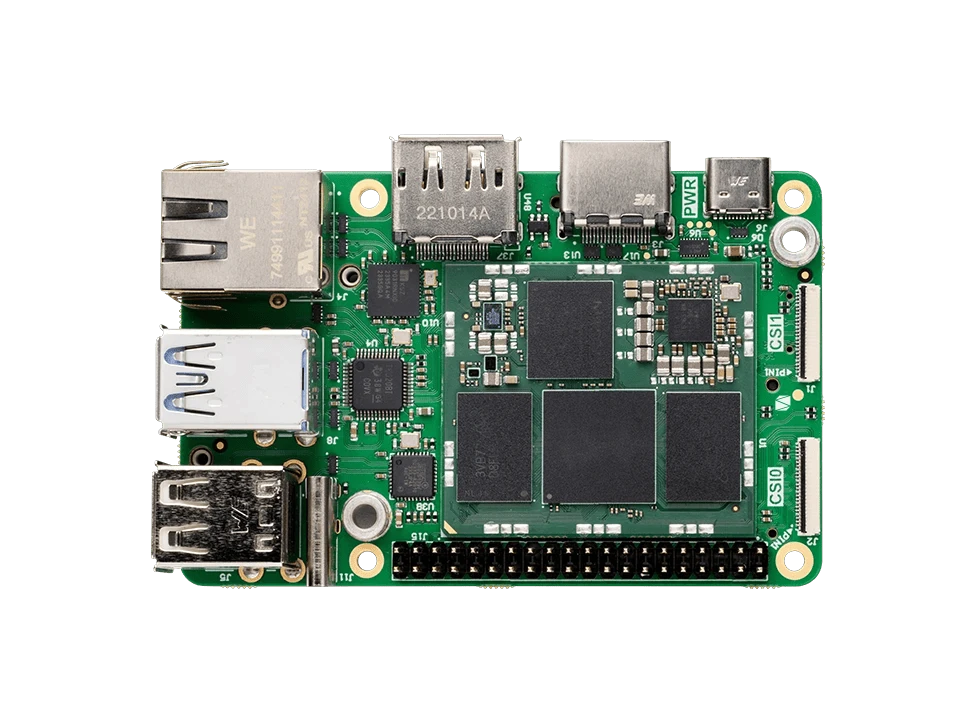
An onboard Infineon OPTIGA Trust M module handles secure key storage and supports compliance with the EU Cybersecurity Resilience Act (CRA).
Because the same board also accepts the Grinn GenioSOM-510, it's a practical way to prototype on the 700 and then check whether the 510 covers your workload at a lower cost point, without redesigning hardware.
The Grinn GenioBoard ships with Yocto Linux and Debian support, and we maintain an open-source BSP on GitHub - so you can start on your application layer instead of bringing up the OS from scratch.
We're currently also developing a Grinn GenioBoard-360, an equivalent evaluation platform for the GenioSOM-360 and 360P family. We'll share more details as availability approaches.
Conclusion
The Grinn GenioSOM product family is based on a long-time, close partnership between Grinn and MediaTek. Our engineers work directly with MediaTek's team, have early visibility into their roadmap, and get supply-chain support. For you, that means the modules are better supported, and stay available for over 10 years after a processor's release date.
If you're still weighing options, or if your requirements don't map cleanly onto one module, our engineering team is ready to help. We work with OEMs across industries to identify the right platform and support the full journey from prototyping to production.



 Paweł Horbanowicz