Introduction
Designing a custom embedded computer around a processor takes a lot of board-level work. Memory, power, high-speed interfaces, storage, and thermal management all have to be designed around the SoC before the application hardware can be added.
System-on-Modules (SOMs) move much of that work onto a pre-designed module. The processor, memory, power management, and supporting components are already integrated and tested, leaving the carrier board to handle the interfaces specific to your product.
At Grinn, we develop SOMs in close collaboration with our semiconductor partners. Our Synaptics-based modules use the Astra processor family, which combines general-purpose computing with dedicated hardware for Edge AI.
In this article, we'll look at the two Synaptics-based SoMs in our portfolio, where each one fits, and the development boards available for getting started.
The Grinn AstraSOM family
The Grinn AstraSOM lineup currently consists of:
They are quite different modules, designed for different applications. The 1680 has considerably more processing capacity, while the 261x puts its processor into a much smaller module and brings a different set of system interfaces.
Both modules can be used as the basis for a custom carrier board. You can first evaluate the processor and software on a development platform, then move to your own board once the application is proven (more on this below).
Grinn AstraSOM-1680
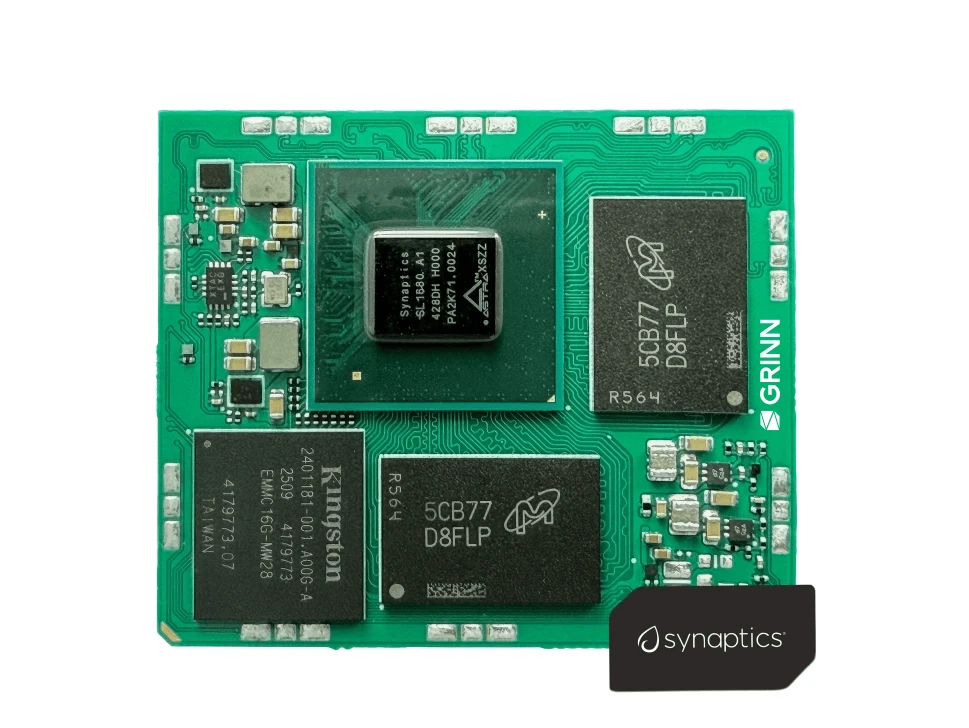
The Grinn AstraSOM-1680 is the performance-oriented member of the Astra family. It uses Synaptics' SL1680 processor with four Arm Cortex-A73 cores running at 2.1 GHz, a PowerVR Series9XE GPU, and an integrated NPU capable of up to 8 TOPS. The module comes with 4 GB of LPDDR4 memory and 16 GB of eMMC storage.
Its video support makes it a natural fit for vision applications. Two MIPI CSI-2 camera inputs and an HDMI input can feed video into the system, while HDMI output and MIPI DSI provide display connectivity.
There is enough processing headroom to run AI inference alongside the rest of the application. A smart camera, for example, can process two camera streams, run an object-detection model, handle network traffic, and maintain its user interface on the same module.
| Specification | Grinn AstraSOM-1680 |
|---|
| SoC | Synaptics Astra SL1680 |
| CPU | 4× Arm Cortex-A73, 2.1 GHz (quad-core) |
| GPU | Imagination PowerVR Series9XE (GE9920) |
| NPU | Up to 8 TOPS |
| RAM | 4 GB 64-bit LPDDR4, 3733 Mbps |
| Storage | 16 GB eMMC |
| Video Input | 2× MIPI CSI-2 (8MP + 4MP), HDMI RX 2.1 |
| Display | MIPI DSI (2160p60), HDMI TX 2.1 (2160p60) |
| Interfaces | USB 3.0, USB 2.0, PCIe Gen2 (2 lanes), Gb Ethernet MAC |
| Form Factor | 37 × 42.6 mm, LGA196 |
| Temperature Range | 0°C to 70°C (Consumer), −40°C to 85°C (Industrial) |
Best use cases
The Grinn AstraSOM-1680 is a strong fit for applications that need a lot of compute and AI performance without giving up board space. Smart cameras, industrial vision systems, robotics, autonomous machines, and AI-enabled industrial controllers are all good candidates.
Multi-camera applications are a particularly natural fit. Video can be processed locally while the CPU handles application logic and communications, with AI inference running on the NPU. That avoids sending camera data to a remote server and keeps the processing close to the source.
We have also used the AstraSOM-1680 in an Edge AI vehicle access control system. As part of that project, two cameras perform vehicle recognition while the AI processing happens locally. It is a good example of where the module's combination of video interfaces and AI compute makes sense.
Grinn AstraSOM-261x
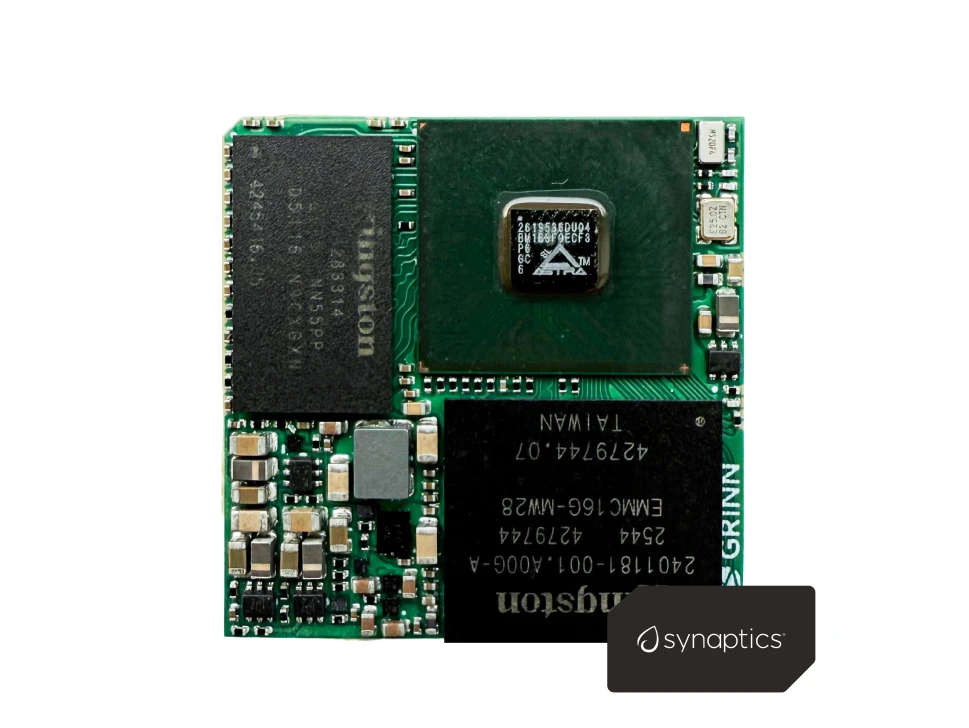
We designed the Grinn AstraSOM-261x to answer the question: how small can the compute platform be without giving up the interfaces needed by a real product?
At just 25 × 25 mm, the module is the world's smallest SoM based on the Synaptics Astra SL2610 family. It combines two Arm Cortex-A55 application cores, a Cortex-M52 system-management domain, a Mali-G31 GPU, and a dedicated 1-TOPS NPU.
The extensive I/O makes it possible to connect the module directly to many of the sensors and peripherals found in industrial equipment.
The Synaptics Torq architecture combines the Torq T1 NPU with a Coral NPU based on Google Research's RISC-V ML core. The platform supports both conventional neural-network workloads and transformer-based models, opening up applications that combine vision, audio, and language processing.
| Specification | Grinn AstraSOM-261x |
|---|
| SoC | Synaptics Astra SL2610 family (dual-core variant) |
| CPU | 2× Arm Cortex-A55, 2 GHz + 1× Cortex-M52, 200 MHz |
| GPU | Arm Mali-G31 |
| NPU | 1 TOPS (Synaptics Torq T1 + Coral NPU) |
| RAM | Up to 2 GB, 16-bit DDR4, 3200 Mbps |
| Storage | 16 GB, up to 64 GB |
| Video Input | 1× MIPI CSI-2 (2-lane) |
| Display | 1× MIPI DSI (4-lane) |
| Interfaces | 2× USB 2.0, 2× Gb Ethernet MAC, 2× CAN-FD |
| Form Factor | 25 × 25 mm, LGA178 |
| Temperature Range | 0°C to 70°C (Consumer), −40°C to 85°C (Industrial) |
Best use cases
Choosing the Grinn AstraSOM-261x makes the most sense when board space and power consumption put limits on the design.
The 25 × 25 mm footprint works well for smart cameras, compact industrial controllers, medical devices, wearables, and smart home products. The low-power modes also make it a candidate for battery-powered or passively cooled designs.
The I/O is another reason to consider it for industrial equipment. Dual Ethernet and CAN-FD can connect the module directly to network and control systems, while the GPIO, UART, I²C, and SPI interfaces leave room for application-specific hardware.
The AI architecture also supports workloads beyond straightforward image classification. Vision, audio, and language processing can run locally, which opens up compact multimodal devices where sending raw sensor data to the cloud is not practical or desirable.
Development boards
You can evaluate both Grinn AstraSOM platforms without designing a custom carrier board first.
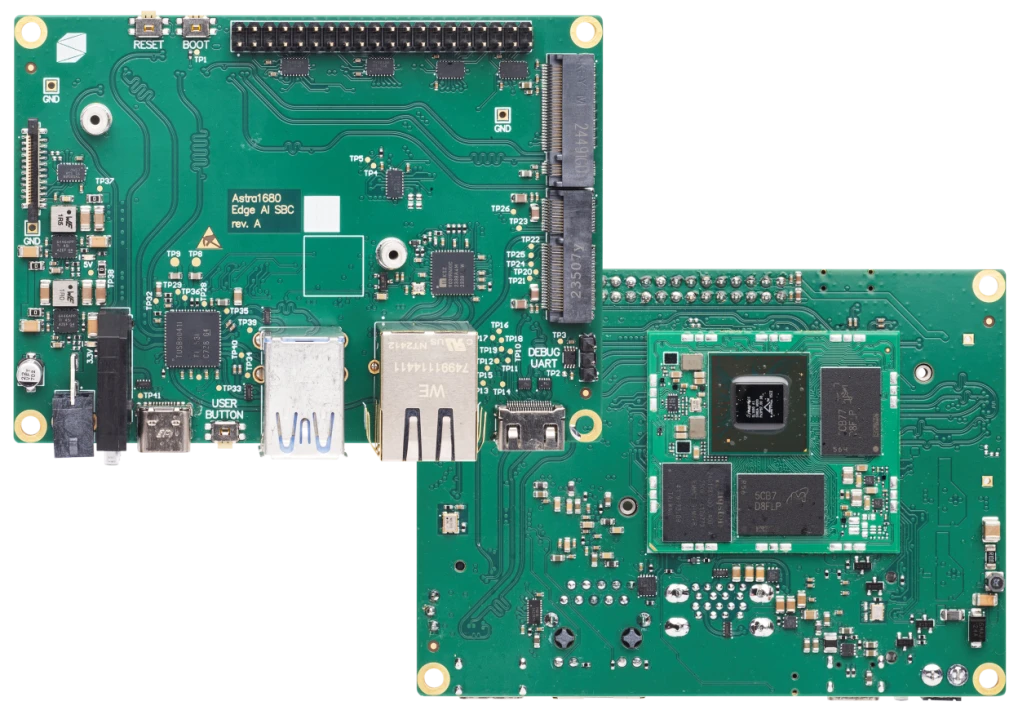
For the Grinn AstraSOM-1680, the Grinn AstraOneSBC-1680 puts the module on a compact 100 × 72 mm Pico-ITX board. It provides Gigabit Ethernet, two USB 3.0 ports, mini-HDMI, a MIPI CSI-2 camera interface, two M.2 slots, and a 40-pin expansion header. The board accepts 12-24 V input and uses passive cooling, so it can also be used as the basis for early industrial prototypes.
For the Grinn AstraSOM-261x, the Synaptics Coralboard provides a ready-made platform built around a production-grade module. Grinn developed the board together with Synaptics and Google Research. It combines the SL2619 with 2 GB of DDR4 memory and a 1-TOPS NPU, along with MIPI CSI camera input, MIPI DSI display output, digital audio, mikroBUS and Qwiic expansion, and an M.2 slot for wireless connectivity. It also supports the Synaptics Torq software platform.
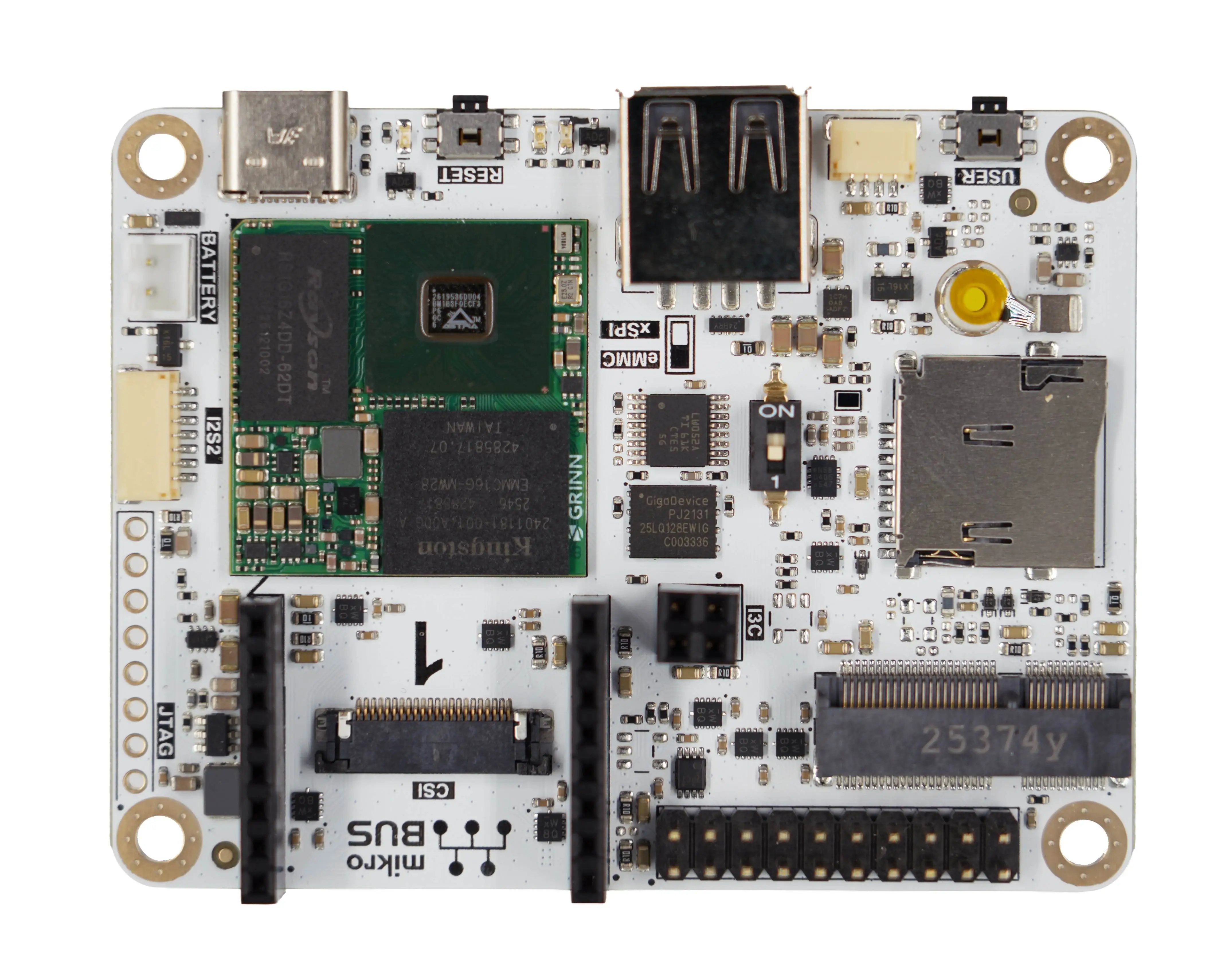
The Coralboard is a good way to validate an application before moving to a custom carrier board. The production module is already on the development board, so the software and AI workload can be developed against the same core hardware that will go into the final product.
We're also currently developing the Grinn AstraTwoSBC-261x, a new SBC based on the AstraSOM-261x and designed with industrial applications in mind. We'll be sharing more details on it soon.
Conclusion
The two Grinn AstraSOM platforms make different trade-offs.
The Grinn AstraSOM-1680 is the better fit when you need more compute. Its specifications make it a good match for demanding computer vision, robotics, smart camera, and industrial AI applications.
The Grinn AstraSOM-261x is designed for smaller products. Its 25 × 25 mm footprint, low-power architecture, industrial I/O, and multimodal AI support make it a better fit when the compute platform has to fit into a tight mechanical envelope.
Both modules come from our work with Synaptics and are supported by Grinn's hardware and embedded software teams. We also offer a 10-year availability guarantee for our SoMs, so a product built around one of these modules does not have to be redesigned every few years simply because the processor has reached the end of its normal availability window.
If you're considering a Synaptics Astra SOM for a new product, the right module will depend mainly on the workload, available board space, power budget, and interfaces you need. Our engineering team can help with the decision and support the project through carrier-board design, software integration, testing, and production.



 Paweł Horbanowicz